
What Is Air Insulated Switchgear (AIS)? Working & Benefits
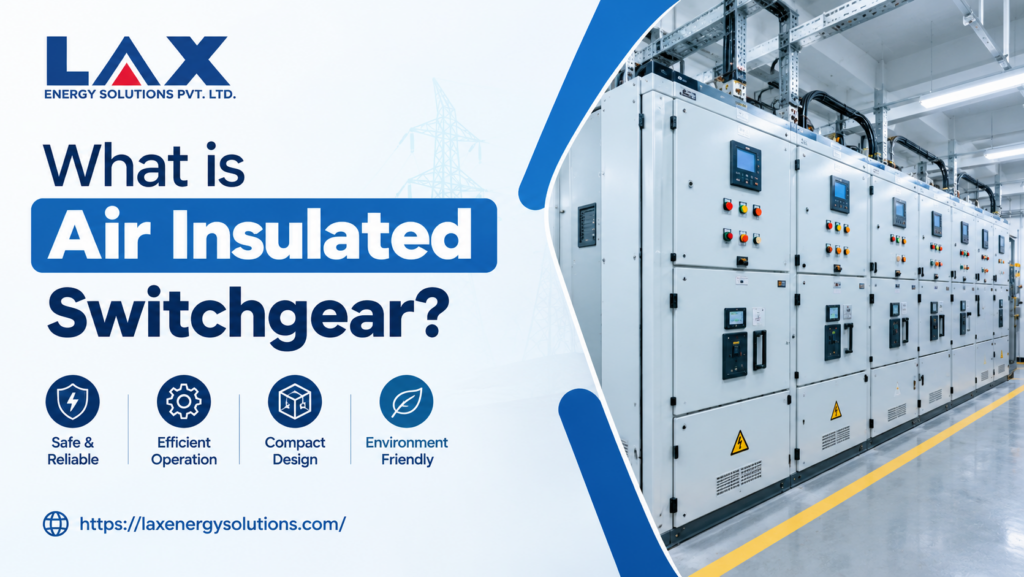
What is air insulated switchgear? It’s electrical switchgear that relies on ordinary air to keep live parts apart. Every distribution system needs something that can switch circuits, clear faults and enable safe switching, fault isolation, and maintenance when appropriate safety procedures are followed. AIS, as it’s usually shortened, turns up in factories, substations and large buildings. Here’s how it works, what’s inside it, where it fits, and what to think about before you specify or maintain one.
What Is Air Insulated Switchgear?
Air insulated switchgear (AIS) is a set of switching, protection and control equipment that uses air at atmospheric pressure as the main insulation between live parts. It opens, closes and protects electrical circuits, and isolates them so equipment can be serviced.
“Air-insulated” describes the gaps. Busbars, contacts and terminals sit at set distances (clearances) from each other and from earthed metal, and the air gaps provide electrical insulation between phases and between live conductors and earthed metal under the specified operating conditions.
Designers like it for a simple reason: you can see and reach most of what matters. The exact build changes with voltage, application and manufacturer, so treat this as a general picture rather than a fixed specification.
How Does Air Insulated Switchgear Work?
Follow the current through a typical panel lineup:
- Power arrives from a transformer or utility feeder through incoming cables.
- Busbars pick it up and share it with several outgoing circuits.
- Each outgoing feeder passes through a circuit breaker that can switch normal load and interrupt fault current.
- Current transformers (CTs) and voltage transformers (VTs) provide scaled electrical signals for metering, monitoring, and protection systems.
- Protection relays compare those readings with their settings. If they see an overcurrent or earth fault, they send a trip command.
- The breaker opens and clears the faulty section. Healthy circuits keep running.
- For maintenance, disconnectors and earthing switches isolate and earth the section before anyone touches it.
The relay detects the fault and initiates a trip command; the circuit breaker interrupts the current.
Main Components of Air Insulated Switchgear
- Busbars: copper or aluminium conductors sized for the rated current and fault level.
- Circuit breakers: make, carry and break current. Vacuum interrupters are common at medium voltage, though other technologies exist.
- Disconnectors and earthing switches: give a verifiable isolation point. Disconnectors generally aren’t meant to break load current.
- Current and voltage transformers: feed metering and protection where the scheme needs them.
- Protection relays: mostly numerical (microprocessor-based) today, and many keep event records that help after a trip.
- Control and metering: local switches, indicators, meters and, often, a link to SCADA.
- Cable compartments: space to terminate and support cables.
- Enclosures and insulators: anything from open outdoor structures to metal-clad indoor cubicles with internal partitions.
Where Is Air Insulated Switchgear Used?
You’ll find AIS in industrial and manufacturing plants, commercial buildings, substations and utility networks, infrastructure such as water treatment and transport, renewable energy sites, and data centres. Indoor switchrooms and outdoor switchyards both use it.
It tends to suit places with enough floor area, manageable conditions, and maintenance crews who already know the equipment. Familiarity with the equipment can help maintenance teams work more efficiently and safely.
Advantages of AIS
- Fairly simple construction, with no gas system to keep pressurised for insulation.
- Easy access for visual checks of contacts, insulators and connections.
- Well-understood maintenance and testing routines.
- Flexible layouts for different feeder counts and busbar arrangements.
- Modular panel designs that can often be extended, within the original design limits.
- Conventional designs don’t use SF6 as the main insulation, although some breakers or switches may still contain it.
None of this makes AIS the automatic winner. Cost depends on space, civil works, site conditions and lifecycle plans, so there’s no general rule.
Limitations of AIS
Air needs distance, so AIS usually takes up more room than compact gas-insulated equipment at similar ratings. Clearances must be kept during installation and any later change. Dust, damp, condensation, salt or industrial pollution can reduce insulation performance, depending on whether the gear is indoors, outdoors, open or enclosed. A dry, ventilated switchroom is a very different place from a coastal yard. Therefore, regular inspection and cleaning are important for maintaining insulation performance and equipment reliability.
AIS vs GIS
Gas insulated switchgear (GIS) seals live parts inside gas-filled compartments, traditionally SF6, with alternatives emerging. General differences are below, and real products vary.
Parameter | AIS | GIS |
Insulation | Atmospheric air | Insulating gas in sealed compartments |
Space | Larger footprint | More compact |
Accessibility | Parts often directly visible | Enclosed; relies on monitoring |
Environment | Exposed to site conditions to varying degrees | Sealed from surroundings |
Maintenance | Inspection, cleaning, testing | Gas monitoring, leak checks, specialised handling |
Installation and cost | Depends on civil works and space | Depends on gas handling and equipment |
Neither is better in every case. Space, voltage, environment, maintenance approach and lifecycle priorities decide it. Our AIS versus GIS comparison goes into more detail.
To know more checkout our blog: https://laxenergysolutions.com/air-insulated-switchgear-vs-gas-insulated-switchgear/
Why Do Testing and Maintenance Matter?
Switchgear sits idle for years, then has to work perfectly in milliseconds. Testing and maintenance are how you make sure it will. A sensible programme covers:
- Visual inspection for tracking marks, corrosion, dirt, loose joints and overheating.
- Electrical tests such as insulation and contact resistance.
- Protection checks on relay settings, CT and VT circuits and trip paths.
- Mechanical checks on breakers, disconnectors and interlocks.
- Spotting early warning signs like hot spots, moisture or partial discharge.
- Commissioning before energisation.
- Keeping records so trends show up over time.
Scope and intervals depend on the equipment, standards and manufacturer guidance. For the wider picture, see this guide to testing, commissioning and maintenance of electrical equipment.
How to Choose the Right AIS?
Start with the system, not the catalogue. Review:
- System voltage and rated current
- Fault withstand requirements
- Number of feeders, now and later
- Indoor or outdoor location and available space
- Temperature, altitude, humidity, pollution and corrosion
- Protection needs and coordination
- Expansion plans and maintenance capability
- Applicable standards (for medium-voltage metal-enclosed gear, often the IEC 62271 series, plus local or utility rules)
- Project specifications
No single rating settles it. A qualified engineer should look at all of these together.
Why Professional Testing and Commissioning Matter?
Good air insulated switchgear can still misbehave if it’s wired wrongly or set incorrectly. Competent people check that the installation matches the design, connections are right, protection settings suit the network and everything operates before energisation. Transport damage and wiring errors are far cheaper to find here than after a fault. Specialist firms such as Lax Energy Solutions offer this kind of testing and commissioning work. Whoever performs the work should follow the manufacturer’s instructions, applicable standards, and safety procedures, and maintain proper records.
Key Takeaways
- AIS uses atmospheric air as the main insulation between live parts and controls, protects and isolates circuits.
- Current flows through busbars and breakers to feeders, while relays trip breakers on faults.
- Main parts are busbars, breakers, disconnectors, instrument transformers, relays, control gear and enclosures, though layouts vary.
- It’s used across industry, utilities, infrastructure, renewables and data centres.
- It offers access and flexibility but needs space, clearances and suitable conditions.
- Commissioning, testing and maintenance keep it dependable.
How Lax Energy Solutions Supports Electrical System Reliability?
Choosing the right switchgear is only one part of maintaining a reliable electrical power system. Proper testing, commissioning, and periodic maintenance also help verify equipment performance and identify potential issues before they lead to unexpected downtime.
Lax Energy Solutions Pvt Ltd provides power system testing and diagnostic services, including electrical equipment testing, condition assessment, and testing and commissioning support for substations and switchgear installations. These services help businesses assess equipment condition, verify installation performance, and plan maintenance based on technical findings and manufacturer recommendations.
Whether you are managing an industrial facility, a power distribution network, or a substation project, professional testing and diagnostics can support safer operation and long-term equipment reliability.
Explore Lax Energy Solutions Pvt Ltd to learn more about its electrical testing, commissioning, and diagnostic services.
Conclusion
Air insulated switchgear uses air as its primary insulating medium and incorporates circuit breakers, busbars, relays, and disconnectors to control and protect electrical networks. It’s accessible and familiar, but it needs room, suitable conditions and steady upkeep. Whether AIS or GIS is the better fit comes down to project requirements, not a general ranking. Get the selection right, commission it properly and keep testing it, and it should serve reliably for years.
FAQ’s
What does AIS mean in switchgear?
AIS stands for air insulated switchgear. Air separates live parts from each other and from earth, while breakers, disconnectors and relays control, protect and isolate circuits.
How does AIS work?
Power enters, busbars distribute it, and breakers switch each feeder. Relays watch for faults and trip the breaker. Disconnectors and earthing switches isolate sections for maintenance.
Where is AIS used?
Industrial plants, commercial buildings, substations, utility networks, infrastructure, renewable sites and data centres, mainly where space and conditions suit it.
What is the difference between AIS and GIS?
AIS insulates with air and is generally more accessible. GIS uses sealed insulating gas and is generally more compact. The project needs to decide which fits.
Does AIS need regular maintenance?
Yes. Scheduled inspection, cleaning, electrical testing, protection checks and mechanical tests are normal, with intervals set by manufacturer guidance and site conditions.